
Review
Clinical Effects of Probiotics Across Health Conditions: An Umbrella Review of Systematic Reviews and Meta-Analyses
Rafaela Nonato de Menezes a,*, Heloísa Lima Silva a, Maysa de Oliveira Barbosa b,c, Maria Neyze Martins Fernandesb, Ernandes Costa Linbraim d, Danilo Ferreira de Sousa e
a Department of Nutrition, Centro Universitário de Juazeiro do Norte (UNIJUAZEIRO), Juazeiro do Norte, Ceará, Brazil
b Universidade Regional do Cariri (URCA), Crato, Ceará, Brazil
c Centro Universitário Maurício de Nassau (UNINASSAU), Brazil
d Universidade Federal do Espírito Santo (UFES), Vitória, Espírito Santo, Brazil
e Universidade Federal do Ceará (UFC), Fortaleza, Ceará, Brazil
ARTICLE INFO
Edited by Dr G Liu
Keywords:
Probiotics
Umbrella review
Meta-analysis
Clinical outcomes
Evidence synthesis
Highlights
- Probiotics should therefore be considered strain- and indication-specific adjuncts rather than a uniform therapeutic class.
ABSTRACT
Probiotics are used across gastrointestinal, infectious, neonatal, metabolic, dermatological, oral, and mental-health settings, but their clinical effects vary by strain, dose, population, and outcome. This umbrella review evaluated systematic reviews with quantitative meta-analysis published between 2018 and 2023. PubMed/MEDLINE, the Cochrane Library, Europe PMC, ScienceDirect, and citation lists were searched for human reviews comparing probiotics with placebo, usual care, or no probiotic. Twelve reviews met the eligibility criteria, and methodological confidence was assessed using AMSTAR 2 principles.
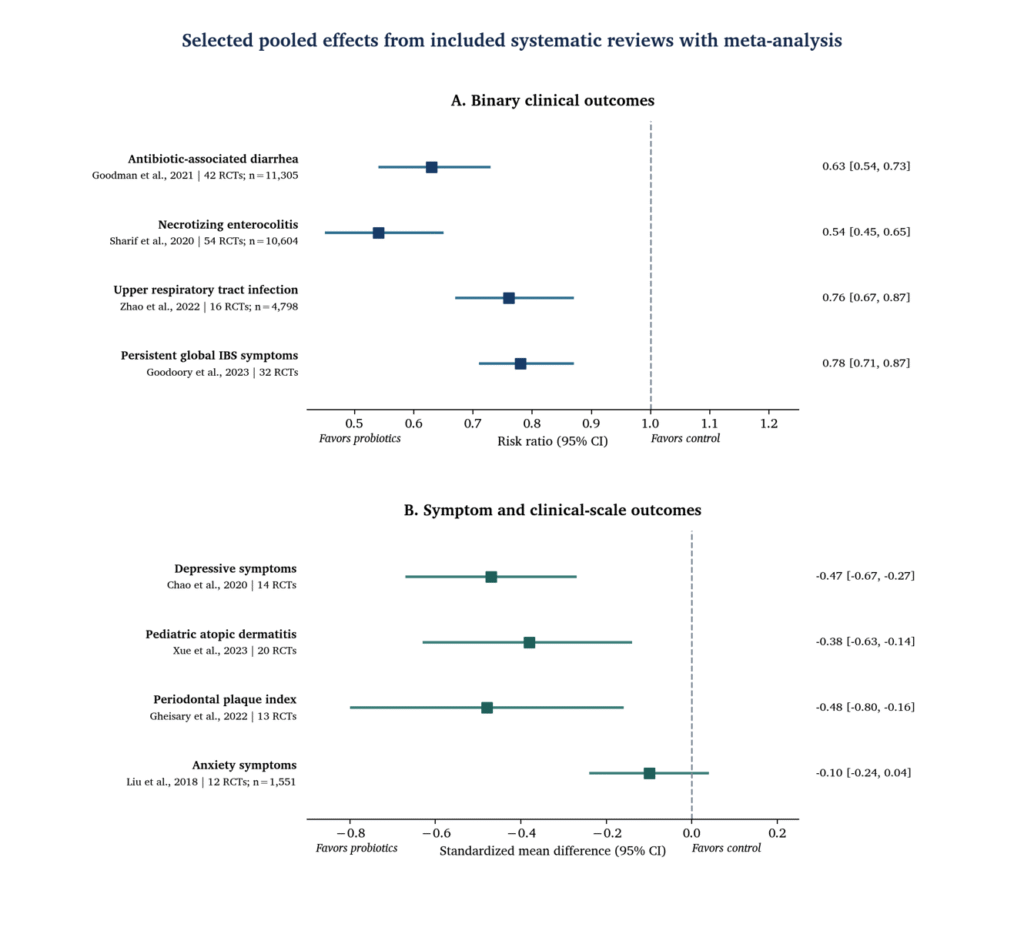
The most consistent benefits were reported for prevention of necrotizing enterocolitis in very preterm or very-low-birth-weight infants (RR 0.54, 95% CI 0.45–0.65), antibiotic-associated diarrhea in adults (RR 0.63, 95% CI 0.54–0.73), acute upper respiratory tract infection (RR 0.76, 95% CI 0.67–0.87), and persistent global symptoms in irritable bowel syndrome (RR 0.78, 95% CI 0.71–0.87). Smaller improvements were observed for functional constipation, glycated hemoglobin, depressive symptoms, pediatric atopic dermatitis, periodontal outcomes, body mass index, and liver enzymes, whereas anxiety findings were inconclusive. Adverse events were generally mild, although safety reporting was incomplete in high-risk populations. Probiotics should therefore be considered strain- and indication-specific adjuncts rather than a uniform therapeutic class.
Article
Probiotics show clinically relevant, though indication-specific, benefits in selected settings. The strongest review-level evidence supports prevention of antibiotic-associated diarrhea and necrotizing enterocolitis, with additional evidence for acute upper respiratory infection prevention and improvement of irritable bowel syndrome symptoms. Benefits for constipation, type 2 diabetes, NAFLD, depression, atopic dermatitis, periodontal disease, and obesity are generally smaller or less certain, while anxiety outcomes remain inconclusive.
This umbrella review demonstrates that probiotics do not constitute a single therapeutic intervention. The clearest evidence concerned prevention of discrete events—antibiotic-associated diarrhea and neonatal necrotizing enterocolitis—where relative effects were substantial and repeatedly observed.
Available online 26 August 2024
2308-8567/© 2024 The Authors. Published by Elsevier Inc. This is an open access article under the CC BY license (http://creativecommons.org/licenses/by/4.0/).