
Review
Associations of modifiable lifestyle and clinical factors with cognitive function in adults with type 2 diabetes
Anahita Golchin , Karen C. Johnson , Denise K. Houston , Jose A. Luchsinger ,
Kristen M. Beavers , Alain G. Bertoni , Haiying Chen , Lynne Wagenknecht ,
Mark A. Espeland a,e,*, for the Action for Health in Diabetes (Look AHEAD) Aging Study Group
a Department of Internal Medicine, Wake Forest University School of Medicine, Winston-Salem, NC, USA
b Department of Preventive Medicine, University of Tennessee Health Science Center, Memphis, TN, USA
c Departments of Medicine and Epidemiology, Columbia University Irving Medical Center, New York, NY, USA
d Division of Public Health Science, Wake Forest University School of Medicine, Winston-Salem, NC, USA
e Department of Biostatistics and Data Science, Wake Forest University School of Medicine, Winston-Salem, NC, USA
ARTICLE INFO
Edited by Dr G Liu
Keywords:
Adiposity
Diabetes control
Physical activity
Cardiorespiratory fitness
Highlights
- Associations that fitness and HbA1c had with cognitive function were independent and additive. No significant associations with cognitive function were found for physical activity or adiposity.
ABSTRACT
Aims: Type 2 diabetes and obesity accelerate cognitive decline. Maintaining salutary levels of multiple lifestyle and clinical risk factors might be expected to protect against this. We examined whether healthier levels of adiposity, cardiorespiratory fitness, physical activity, and diabetes control were associated with better cognitive functioning.
Methods: Data are from the Action for Health in Diabetes clinical trial of adults with type 2 diabetes and over- weight or obesity. Standardized measures of body mass indices, percent body fat, objective and self-reported physical activity, cardiorespiratory fitness, and HbA1c were collected across 4 and 8 years. Associations be- tween healthier versus less healthy levels (categorized based on ± one standard deviation from the cohort mean) of these measures with subsequent standardized (z-scores) assessments of cognitive function were assessed using linear regression.
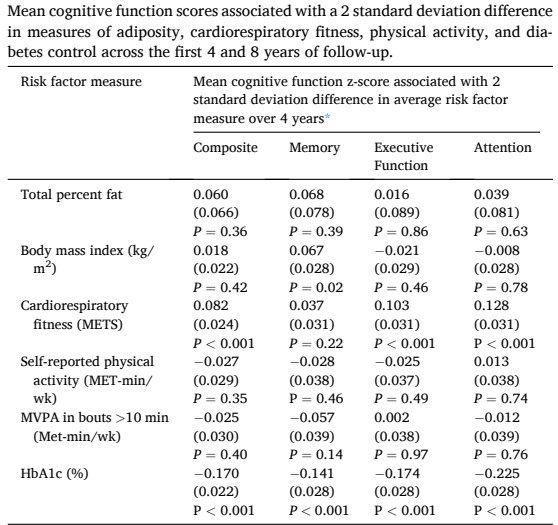
Results: Among 3723 participants, high versus low cardiorespiratory fitness was associated with 0.08 to 0.13 standard deviation better global cognitive function, executive function, and attention (p < 0.001). Lower versus high HbA1c was associated with 0.17 to 0.22 standard deviation better cognitive function for all domains (p < 0.001). Associations that fitness and HbA1c had with cognitive function were independent and additive. No significant associations with cognitive function were found for physical activity or adiposity.
Conclusions: Maintaining greater cardiorespiratory fitness and better diabetes control may protect cognitive function in type 2 diabetes.
Article
The magnitude of differences we see in composite cognitive function associated with increased cardiorespiratory fitness and lower HbA1c, ranging from 0.08 to 0.17 standard deviations, may appear modest.
This cannot be gauged accurately based on observed changes over time due to the well-known phenomenon of practice effects, which is that test scores tend to increase with repeat assessments as individuals become more accustomed. An indirect com- parison may be generated by examining the regression slope of scores from the initial assessment versus age.
Available online July 7, 2026
2308-8567/© 2026 The Authors. Published by Elsevier Inc. This is an open access article under the CC BY license (http://creativecommons.org/licenses/by/4.0/).