
Review
Effects of Bariatric and Metabolic Surgery on Steatohepatitis Resolution and Liver Fibrosis Regression in Adults with MASLD: A Systematic Review and Meta-Analysis
Maria Eveline do Nascimento Pereira Vieira a, Joaquim Máximo da Silva b, Juan Bringel Gonçalves Lobo b, Igor Maciel Silvab, Maria Cláudia Queiroz de Castro b, Alberto Vaughon Jennings Neto b, Givaldo Alves dos Santos b, Neyton Carlos da Silva b, Nélio Barreto Vieira b,*
a CECAPE College, Juazeiro do Norte, Ceará, Brazil
b School of Medicine, Federal University of Cariri (UFCA), Barbalha, Ceará, Brazil
ARTICLE INFO
Edited by Dr G Liu
Keywords:
MASLD
MASH
Bariatric surgery Liver fibrosis
Systematic review
Meta-analysis
Highlights
- Certainty was moderate for MASH resolution based on comparative evidence and low for single-arm proportions and fibrosis regression because of selection for repeat biopsy and methodological heterogeneity.
ABSTRACT
Objective: To synthesize the effects of bariatric and metabolic surgery on histological resolution of metabolic dysfunction-associated steatohepatitis (MASH), improvement in fibrosis, and long-term liver outcomes in adults with obesity. Methods: A systematic review was conducted in accordance with PRISMA 2020. MEDLINE/PubMed and ClinicalTrials.gov were searched from database inception through July 16, 2026, supplemented by reference and citation tracking. Clinical trials, comparative studies, and cohorts with paired liver biopsies or major liver outcomes were included. Proportions were pooled after logit transformation; adjusted hazard ratios (HRs) were synthesized on the logarithmic scale. Random-effects models, restricted maximum likelihood estimation, and 95% confidence intervals (95% CIs) were used. Results: Sixteen studies contributed to the qualitative synthesis and 15 to at least one meta-analysis. Across nine studies, 263 of 336 participants achieved histological resolution of MASH/NASH without worsening of fibrosis.
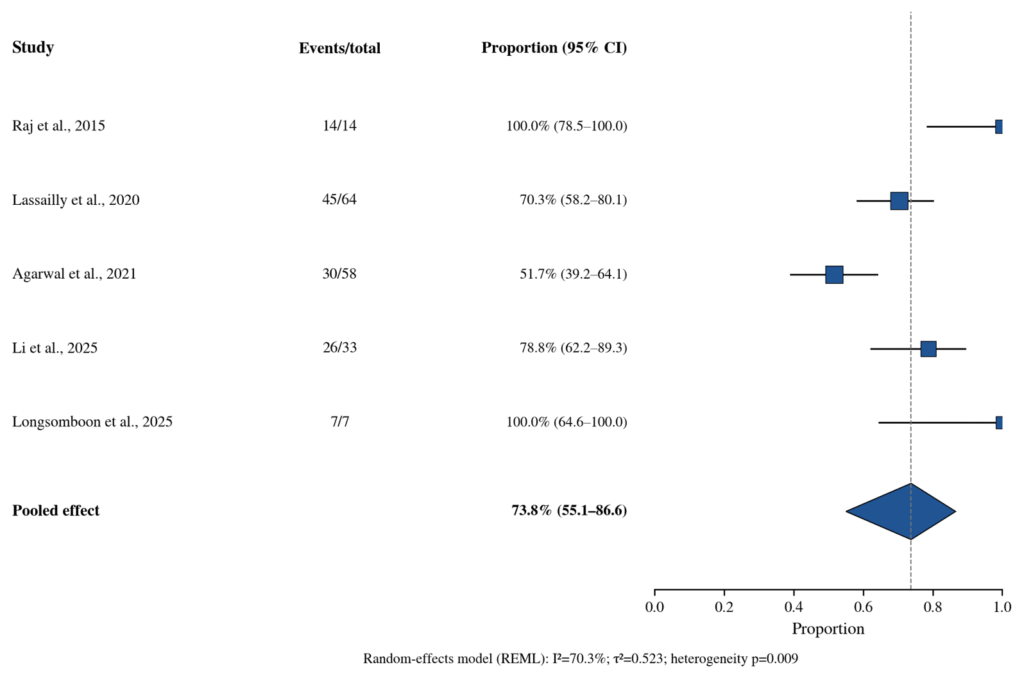
The pooled proportion was 81.2% (95% CI 73.6–87.0%; I²=35.3%). Across five studies, the pooled proportion with improvement or regression of fibrosis was 73.8% (95% CI 55.1–86.6%; I²=70.3%). In the BRAVES trial, NASH resolution was more frequent after gastric bypass or sleeve gastrectomy than after intensive lifestyle intervention. Three controlled cohorts totaling 10,152 participants indicated a lower risk of progression to cirrhosis or major adverse liver outcomes after surgery (pooled HR=0.29; 95% CI 0.19–0.43; I²=0%). Conclusion: Bariatric and metabolic surgery was associated with a high frequency of MASH resolution and fibrosis improvement, as well as a lower risk of long-term liver disease progression. Certainty was moderate for MASH resolution based on comparative evidence and low for single-arm proportions and fibrosis regression because of selection for repeat biopsy and methodological heterogeneity.
Article
This review indicates that bariatric and metabolic surgery is associated with histological resolution of MASH in approximately four of every five patients who underwent serial biopsies. Improvement or regression of fibrosis was also frequent, although less uniform and more time-dependent. The most relevant finding is the convergence of different levels of evidence: paired cohorts showed reversal of histological activity, the randomized trial demonstrated superiority over intensive medical treatment, and long-term controlled studies indicated less progression to cirrhosis and major liver outcomes.
Bariatric and metabolic surgery was associated with a high frequency of histological resolution of MASH/NASH without worsening fibrosis and with fibrosis improvement in a substantial proportion of patients with obesity.
Available online September 27, 2026
2308-8567/© 2026 The Authors. Published by Elsevier Inc. This is an open access article under the CC BY license (http://creativecommons.org/licenses/by/4.0/).