
Review
Monogenic diabetes in Japan and India: A call for broader screening
Masashi Hasebe a,b,c,1 , Venkatesan Radha d,1 , Anandakumar Amutha d ,
Daisuke Tanaka a,e , Toshinori Imaizumi a , Daisuke Yabe a , Satoshi Yoshiji a,b,2,* , Nobuya Inagaki a,c,2,* , Viswanathan Mohan d,f,2,* , on behalf of PAN INDIA Monogenic Study Collaborators Group and Japan Diabetes Society Monogenic Diabetes Committee
a Department of Diabetes, Endocrinology and Nutrition, Kyoto University Graduate School of Medicine, Kyoto 606-8507, Japan
b Department of Human Genetics, McGill University, Montreal, ´ Quebec ´ H3A 0G1, Canada
c Department of Diabetes and Endocrinology, Medical Research Institute KITANO HOSPITAL, PIIF Tazuke-Kofukai, Osaka 530-8480, Japan
d Madras Diabetes Research Foundation (ICMR Collaborating Centre of Excellence), Chennai, Tamil Nadu 600 086, India
e Department of Diabetes and Endocrinology, Shiga General Hospital, Shiga 524-8585, Japan
f Dr. Mohan’s Diabetes Specialities Centre (IDF Centre of Excellence in Diabetes Care), Chennai, Tamil Nadu 600 086, India
ARTICLE INFO
Edited by Dr G Liu
Keywords:
Genetic testing MODY
Monogenic diabetes Young-onset diabetes Japan
India
Highlights
- These findings call for broader genetic testing in Asia beyond classical clinical screening criteria.
ABSTRACT
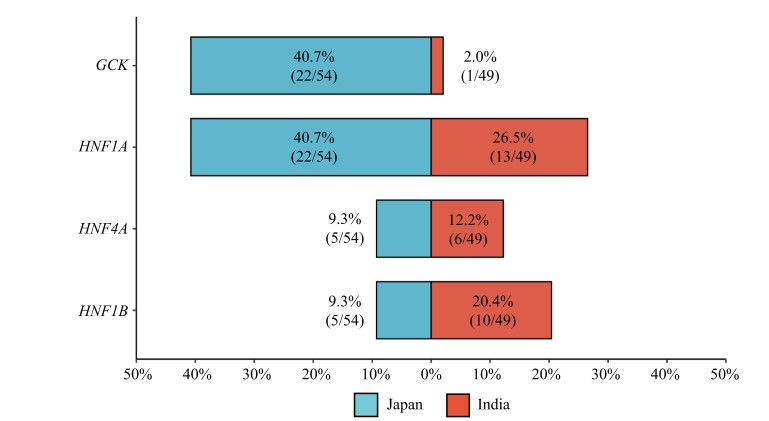
Nationwide cohorts from Japan and India show monogenic diabetes is present in a considerable proportion of young, non-obese individuals with diabetes.
Clinical presentations are heterogeneous; notably, only up to ~ 70% of cases had three-generation family history. These findings call for broader genetic testing in Asia beyond classical clinical screening criteria.
Article
In summary, two referral-based cohorts from Japan and India high- lighted both shared and divergent features across distinct settings.
A clinically meaningful proportion of young, non-obese individuals had monogenic diabetes in both cohorts, and cross-cohort comparisons revealed that (i) the absence of a three-generation family history should not deter clinicians from considering genetic testing and (ii) clinical features show substantial heterogeneity even within the same subtype. These findings underscore the heterogeneity of monogenic diabetes and the importance of broader genetic testing across Asian populations and beyond, particularly for suspected MODY.
Available online July 14, 2026
2308-8567/© 2026 The Authors. Published by Elsevier Inc. This is an open access article under the CC BY license (http://creativecommons.org/licenses/by/4.0/).