
Review
Seven decades after the Asian influenza pandemic: A historical review about immunity and vaccines against H2N2
Alina Tscherne a,, Florian Krammer a,b,c,d,e,
a Ignaz Semmelweis Institute, Interuniversity Institute for Infection Research, Medical University of Vienna, Vienna, Austria
b Ludwig Boltzmann Institute for Science Outreach and Pandemic Preparedness at the Medical University of Vienna, Vienna, Austria
c Department of Microbiology, Icahn School of Medicine at Mount Sinai, New York, NY, USA
d Center for Vaccine Research and Pandemic Preparedness (C-VaRPP), Icahn School of Medicine at Mount Sinai, New York, NY, USA
e Department of Pathology, Molecular and Cell-Based Medicine, Icahn School of Medicine at Mount Sinai, New York, NY, USA
ARTICLE INFO
Edited by Dr G Liu
Keywords:
Asian influenza
pandemic H2N2
Pre-existing immunity
Pandemic preparedness
Vaccines
Highlights
- This review aims to summarize the key historical milestones of the Asian influenza pandemic, the impact of H2N2 immunity during and after the 1957 pandemic, the immunogenicity of H2N2-specific vaccines in both a pandemic and pre-pandemic situation, and H2N2-specific antiviral treatment.
ABSTRACT
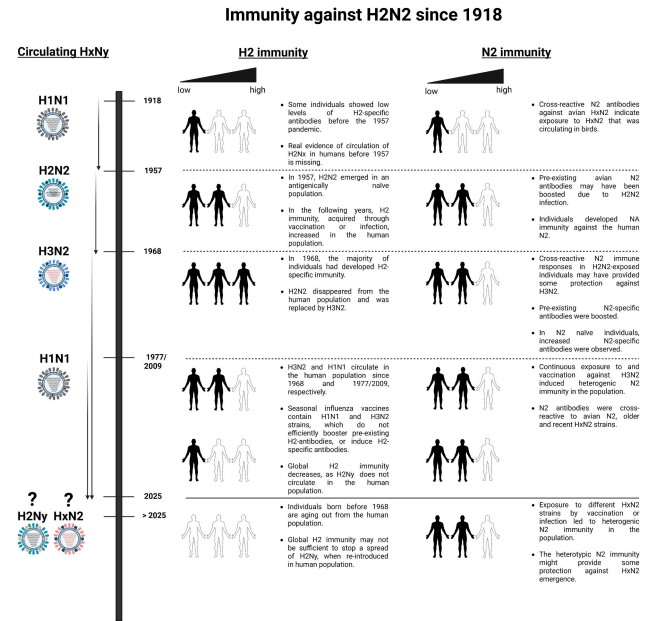
In 1957, a reassortant influenza A virus (IAV) H2N2 subtype emerged in humans and encountered a population that was antigenically naïve to this subtype. The lack of pre-existing immunity to the H2 hemagglutinin (HA) facilitated efficient human-to-human transmission, and by the end of the Summer of 1957, most countries around the world reported increasing influenza cases caused by the new influenza virus subtype. The pandemic lasted until 1958, resulting in millions of infections globally, with 1–4 million estimated deaths. The first vaccines targeting specifically the H2N2 subtype were available in autumn 1957, but their limited immunogenicity hampered a successful fight against the “Asian influenza pandemic”. After the pandemic, H2N2 became seasonal in the following years. Most individuals developed immunity against both the H2 HA and N2 neuraminidase (NA) proteins of the virus, and vaccines administered in the early 1960s successfully boosted this immunity. In 1968, the circulating H2N2 was replaced by the H3N2 subtype, and individuals with pre-existing N2 immunity were partially cross-protected against severe H3N2 infection, as the two N2 NAs were antigenically similar. Since the disappearance of H2N2 from the human population in 1968, global H2 immunity has been decreasing.
This raises concerns about a possible re-emergence of the H2 subtype from animal reservoirs, where the virus has circulated for decades, into the human population. As preparedness for future pandemics, research on H2-specific vaccines is currently ongoing, with several candidates being tested in preclinical studies and early-phase clinical trials. In contrast to 1957, vaccine technology platforms, but also the assays used to assess vaccine immunogenicity, and efficacy, have significantly improved. This review aims to summarize the key historical milestones of the Asian influenza pandemic, the impact of H2N2 immunity during and after the 1957 pandemic, the immunogenicity of H2N2-specific vaccines in both a pandemic and pre-pandemic situation, and H2N2-specific antiviral treatment.
Article
It has been almost 70 years since the H2N2 pandemic and almost 60 years since the virus disappeared from the human population.
Although vaccine technologies have improved, inducing strong immune responses to influenza viruses to which individuals are naïve remains challenging as seen with H5N1 and H7N9 vaccines. Furthermore, far less effort is being put into preparing for a potential H2 pandemic than into pandemic preparedness for H5N1.
Available online July 14, 2026
2308-8567/© 2026 The Authors. Published by Elsevier Inc. This is an open access article under the CC BY license (http://creativecommons.org/licenses/by/4.0/).