
Review
Effectiveness of Probiotics in Controlling Hypertension in Patients with Kidney Disease: MetaUmbrella
Rafaela Nonato de Menezesa,*, Leila Silveira Vieira Bezerrab, Nélio Barreto Vieirab, Francisco De Assis Moura Batistac, Márcio Flávio Moura de Araújod, Danilo Ferreira de Sousae
a Department of Nutrition, Centro Universitário de Juazeiro do Norte (UNIJUAZEIRO), Juazeiro do Norte, Ceará, Brazil
b Universidade Federal do Cariri (UFCA), Barbalha, Ceará, Brazil
c Centro Universitário Maurício de Nassau de Juazeiro do Norte (UNINASSAU), Juazeiro do Norte, Ceará, Brazil / Universidade Federal do Rio Grande do Norte, UFRN, Brasil.
d Fundação Oswaldo Cruz (Fiocruz Ceará), Eusébio, Ceará, Brazil
e Universidade Federal do Ceará (UFC), Fortaleza, Ceará, Brazil / Faculdade CECAPE
ARTICLE INFO
Edited by Dr G Liu
Keywords:
Probiotics
Hypertension
Chronic kidney disease
Gut microbiota
Blood pressure
Umbrella review
Meta-analysis
Highlights
- Probiotics should not currently be prescribed as a replacement for evidence-based blood-pressure therapy in CKD. If a probiotic is used for another supported indication or as part of a supervised nutrition strategy, any BP effect should be considered ancillary. Clinicians should verify strain identity, viable dose, product quality, renal dietary compatibility, and the patient’s clinical vulnerability. Products with poorly defined strain composition or unverified viable counts cannot be assumed equivalent to those studied in randomized trials.
ABSTRACT
Hypertension is highly prevalent in chronic kidney disease (CKD), and gut dysbiosis has been linked to vascular dysfunction, inflammation, and retention of microbial metabolites. This focused meta-umbrella review evaluated whether probiotics improve blood-pressure control in kidney disease using evidence published from 2015 through 31 August 2025. Searches were structured in PubMed/MEDLINE, the Cochrane Library, Europe PMC, and citation-indexed sources and synthesized as two complementary streams: CKD/dialysis reviews and blood-pressure-focused probiotic reviews. Seventeen review-level syntheses met the framework (11 renal and 6 BP-focused). None of the CKD meta-analyses provided a pooled systolic or diastolic BP estimate.
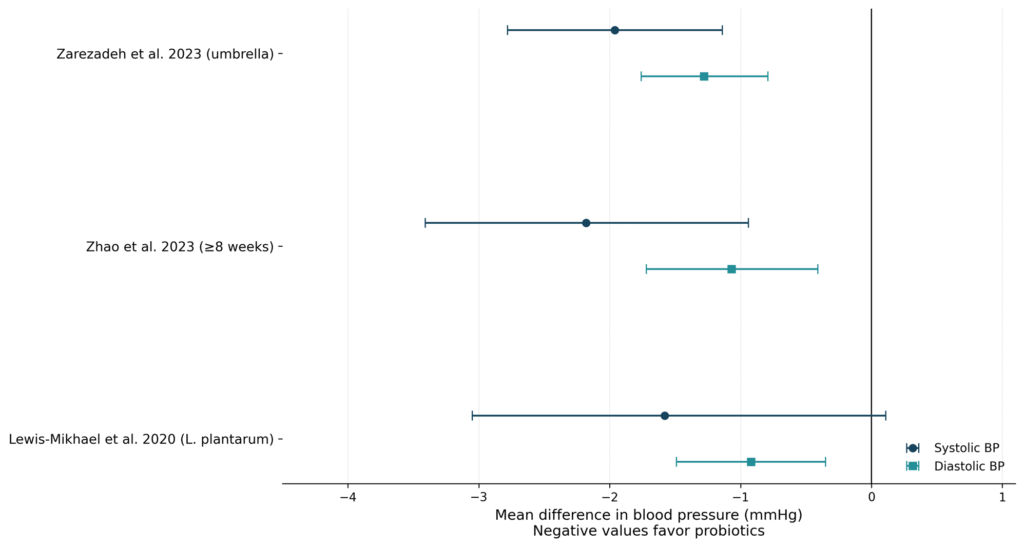
In broader populations, the 2023 umbrella meta-analysis of 14 meta-analyses (15,494 participants) reported modest reductions in systolic BP (WMD −1.96 mmHg, 95% CI −2.78 to −1.14) and diastolic BP (WMD −1.28 mmHg, 95% CI −1.76 to −0.79); a long-term RCT meta-analysis found similar office reductions (−2.18/−1.07 mmHg). The 2025 overweight/obesity update found no significant systolic effect and only a small diastolic effect. CKD reviews more consistently reported changes in selected uremic toxins, BUN, inflammation, or oxidative stress than cardiovascular outcomes. Probiotics therefore show a small antihypertensive signal in general cardiometabolic populations, but effectiveness for CKD-associated hypertension remains unproven and indirect. They should not replace established antihypertensive or kidney-protective therapy.
Article
Earlier CKD meta-analyses suggested that probiotics or broader biotic interventions can affect selected biological pathways relevant to vascular health without proving antihypertensive efficacy. Jia et al. reported lower p-cresyl sulfate (SMD −0.57, 95% CI −0.99 to −0.14), whereas Tao et al. found reduced urea in nondialysis CKD but no significant effect on creatinine, eGFR, uric acid, or C-reactive protein [10,14].
Renal surrogate outcomes should be interpreted as hypothesis-supporting rather than antihypertensive endpoints. Reductions in p-cresyl sulfate, indoxyl sulfate, BUN, oxidative stress, or inflammatory markers may be biologically desirable, but these outcomes do not establish lower cardiovascular event rates or sustained BP reduction.
Available online December 14, 2025
2308-8567/© 2025 The Authors. Published by Elsevier Inc. This is an open access article under the CC BY license (http://creativecommons.org/licenses/by/4.0/).