
Article
Interrelated Dynamics of Psychological, Sociodemographic, and Physical Activity Factors in Post-Bariatric Weight Regain
Maria Eveline Nascimento Pereira Vieira1; Igor Maciel Silva2; Joaquim Máximo da Silva3; Juan Bringel Gonçalves Lobo4; Nélio Barreto Vieira5
1 Nutritionist. Centro Universitário Maurício de Nassau; eveline09-menp@hotmail.com
2 Medical Student. Universidade Federal do Cariri – UFCA; igor.maciel@aluno.ufca.edu.br
3 Medical Student. Universidade Federal do Cariri – UFCA; joaquim.maximo@aluno.ufca.edu.br
4 Medical Student. Universidade Federal do Cariri – UFCA; bringel.juan@aluno.ufca.edu.br
5 Doctor of Health Sciences. Universidade Federal do Cariri – UFCA. Brazil; nelio.barreto@ufca.edu.br*.
ARTICLE INFO
Edited by Dr G Liu
Keywords:
Obesity;
Bariatric surgery;
Adaptive complex system;
Network analysis.
Highlights
- Measures of centrality highlighted disinterest and negative affectivity, along with most items on the depression, anxiety, and stress scale, as having the highest expected influence (ranging from 1.043 to 1.502).
ABSTRACT
Weight regain occurs in approximately 10 to 20% of individuals following bariatric surgery and remains a complex and multifactorial phenomenon, which makes both its understanding and management particularly challenging. This study aimed to explore the associations between weight regain and psychological, sociodemographic, and behavioral factors, using a network analysis approach. The study sample comprised 124 patients of both sexes, with a mean age of 39 ± 9.1 years, all of whom had undergone bariatric surgery at least 18 months prior. After providing informed consent, participants completed a series of questionnaires via the Google Forms platform.
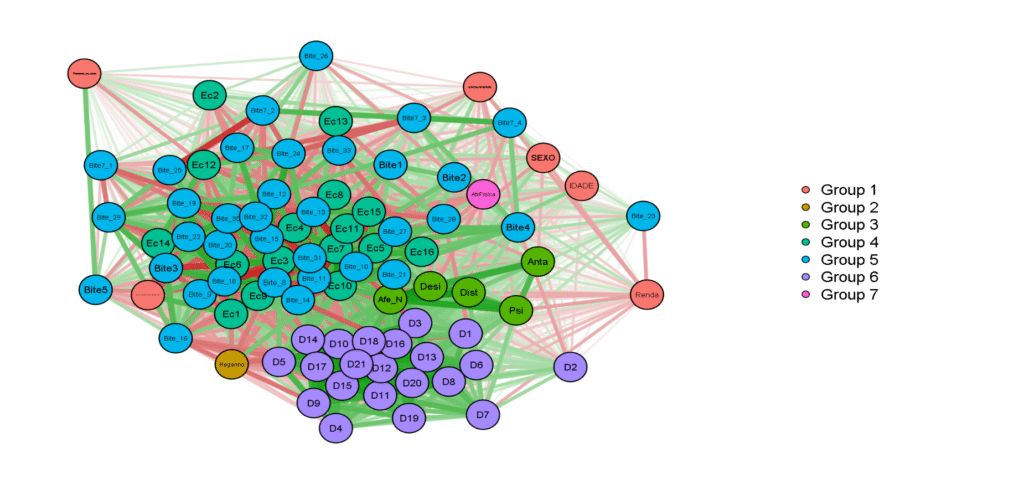
The findings revealed a negative correlation between weight regain and indicators of depression, anxiety, stress, binge eating, and specific personality traits, including negative affectivity (−0.182), detachment (−0.078), antagonism (−0.107), disinterest (−0.198), and psychoticism (−0.158). Measures of centrality highlighted disinterest and negative affectivity, along with most items on the depression, anxiety, and stress scale, as having the highest expected influence (ranging from 1.043 to 1.502). These variables emerged as key targets for intervention and deserve greater clinical attention from healthcare professionals.
Article
Therefore, the present study provided a new approach to evaluate interactions in weight relapse and correlates it as a complex adaptive system. Depressive, anxious and compulsive behaviors, high levels of stress and personality traits, such as disinterest and negative affectivity, are the variables that most influenced weight regain in patients undergoing bariatric surgery.
The centrality indicators also allowed us to assess which variables are most sensitive to the intervention and those which will most quickly receive the intervention effect. In this case, we highlighted the personality traits (disinterest and negative affectivity) and high scores of depression, anxiety and stress. Thus, these data can support public policies in order to promote mental health for this population. Finally, longitudinal and multicenter studies are needed to better assess this issue.
Available online 21 June 2026
0147-6513/© 2026 The Authors. Published by Elsevier Inc. This is an open access article under the CC BY license (http://creativecommons.org/licenses/by/4.0/).