
Review
Mindfulness-Based Interventions Across Chronic Diseases: An Umbrella Review and Second-Order Meta-Analysis of Depressive Symptoms and Patient-Centered Outcomes
Danilo Ferreira de Sousa¹; Marcelo Silva Amorim²; Aretha Feitosa de Araújo³,⁴; Leandro Menezes Cavalcante²; Vitória Maria Carvalho de Azevêdo⁵; Melinda Dante Araújo⁶
¹ Independent Researcher, Brazil; prof.danilofersousa@gmail.com*
² Federal University of São Paulo (UNIFESP), São Paulo, Brazil.
³ Faculdade CECAPE, Ceará, Brazil.
⁴ Regional University of Cariri (URCA), Ceará, Brazil.
⁵ UniFacema University Center, Maranhão, Brazil.
⁶ Federal University of Espírito Santo (UFES), Espírito Santo, Brazil.
ARTICLE INFO
Edited by Dr G Liu
Keywords:
Mindfulness;
Chronic disease;
Umbrella review;
Meta-analysis;
Depression;
Integrated care.
Highlights
- Across diverse chronic diseases, mindfulness-based interventions were associated with a moderate reduction in depressive symptoms and a broader pattern of benefit for anxiety, stress, coping, and quality of life.
ABSTRACT
Chronic diseases impose sustained psychological and behavioral burdens that can amplify symptoms, reduce adherence, and impair quality of life. Mindfulness-based interventions (MBIs) are increasingly used as adjuncts to chronic disease care, but their effects are dispersed across disease-specific reviews. This umbrella review synthesized systematic reviews and meta-analyses of MBIs in adults with chronic diseases and performed a second-order meta-analysis of comparable depression outcomes. PubMed/MEDLINE and the Cochrane Library were searched from inception to July 1, 2026, with backward citation searching and targeted searches of journal repositories. Eligible reports were systematic reviews with meta-analysis of randomized or controlled trials evaluating structured MBIs in chronic disease populations. To limit double counting, one condition-specific estimate per disease category was selected for the quantitative synthesis. Standardized mean differences (SMDs) were harmonized so negative values favored MBIs and pooled with a random-effects restricted maximum likelihood model using Hartung-Knapp inference.
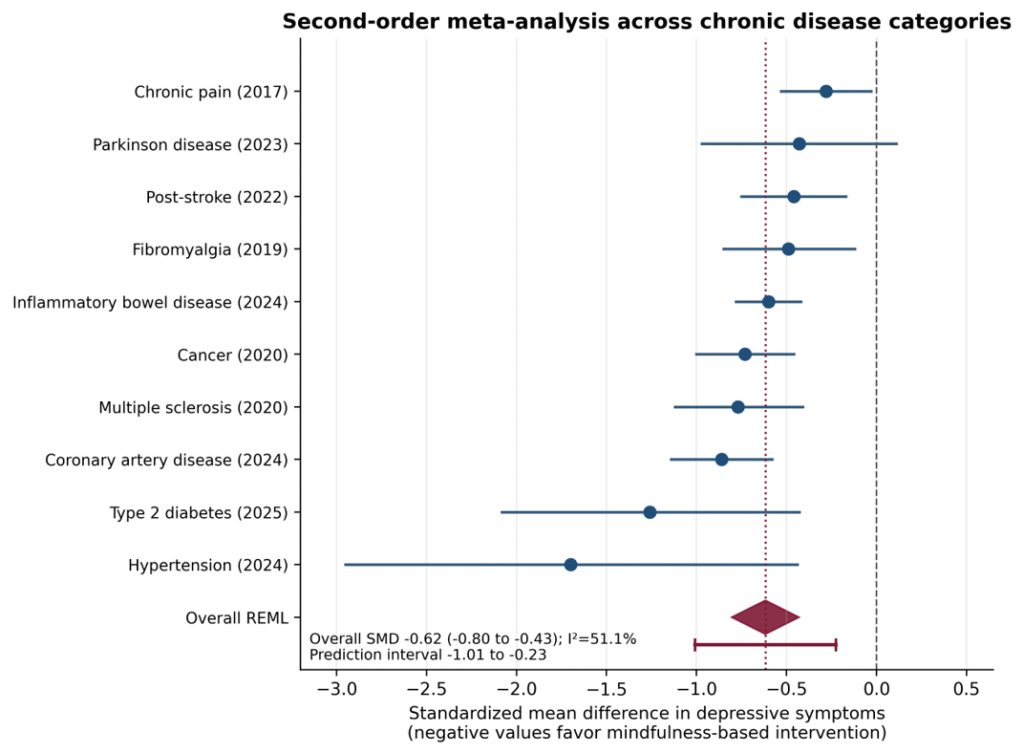
Twelve reviews informed the umbrella synthesis and 10 condition-specific estimates entered the second-order meta-analysis. Across cancer, fibromyalgia, type 2 diabetes, multiple sclerosis, Parkinson disease, chronic pain, inflammatory bowel disease, coronary artery disease, post-stroke populations, and hypertension, MBIs were associated with lower depressive symptom burden (pooled SMD = -0.62, 95% CI -0.80 to -0.43). Heterogeneity was moderate (I² = 51.1%; Q = 18.41, p = 0.031), and the 95% prediction interval (-1.01 to -0.23) remained in the direction of benefit. Leave-one-out estimates ranged from -0.66 to -0.58. Benefits were most consistent for depression, anxiety, stress, pain-related coping, and quality of life, whereas physiological outcomes such as blood pressure and glycemic control were more condition-dependent and supported by lower-certainty evidence. MBIs appear to provide a clinically meaningful adjunctive strategy across chronic diseases, particularly for psychological distress, but implementation should complement rather than replace disease-specific treatment.
Article
This umbrella review identified a consistent cross-disease signal: structured MBIs are associated with meaningful reductions in depressive symptoms among adults living with chronic disease.
The principal research priority is not simply to produce more small efficacy trials. Future studies should use active comparators when appropriate, prespecify core outcomes, report instructor competence and intervention fidelity, assess adverse events, and include sufficient follow-up to determine durability.
Available online July 7, 2026
0147-6513/© 2026 The Authors. Published by Elsevier Inc. This is an open access article under the CC BY license (http://creativecommons.org/licenses/by/4.0/).