
Review
Oral Health and Cardiovascular Outcomes: An Umbrella Review and Updated Meta-Analysis of Periodontal Disease, Tooth Loss, and Oral-Hygiene Indicators
Rafaela Nonato de Menezesa*, Regina Petrola Bastos Rochab, Wilma Francisca da Silvac, Leila Silveira Vieira Bezerrad, Danilo Ferreira de Sousa e
a Graduate Program in Biotechnology, Federal University of Ceará (UFC), Fortaleza, Ceará, Brazil
b Faculdade CECAPE, Juazeiro do Norte, Ceará, Brazil
c Postgraduate Program in Health Education, Dr. Leão Sampaio University Center (UNILEÃO), Juazeiro do Norte, Ceará, Brazil / Faculdade CECAPE, Juazeiro do Norte, Ceará, Brazil
d Federal University of Cariri (UFCA), Juazeiro do Norte, Ceará, Brazil
e Federal University of Ceará (UFC), Fortaleza, Ceará, Brazil / Universidade Federal de São Paulo(UNIFESP), Public Health Program.
ARTICLE INFO
Edited by Dr G Liu
Keywords:
Oral health
Periodontitis
Tooth loss
Cardiovascular diseases
Meta-analysis
Highlights
- Apical periodontitis showed weaker and less consistent longitudinal evidence than marginal periodontitis. The 2022 synthesis found an association in cross-sectional studies (OR 1.53) but not in two cohorts (RR 1.27, 95% CI 0.71-2.27).
ABSTRACT
Background: Periodontal disease, tooth loss, and unfavorable oral-hygiene behaviors may identify adults at increased cardiovascular risk, but the evidence spans heterogeneous exposures and endpoints. Methods: We conducted an umbrella review of systematic reviews with quantitative synthesis and a reanalysis of adjusted longitudinal estimates. PubMed/MEDLINE was the primary source; searches were complemented by Europe PMC, the Cochrane Library, OpenAlex, Crossref, and citation tracking. Database-specific strategies were developed for Embase, Scopus, and Web of Science Core Collection. Searches covered 1 January 2015 through 28 February 2026. Random-effects models were fitted on the log ratio scale. Results: Fifteen reviews were included. The reanalysis of 26 longitudinal reports consistently oriented toward adverse oral-disease exposure yielded a pooled ratio measure of 1.55 (95% CI 1.35-1.78; I²=92.4%), with a wide 95% prediction interval (0.78-3.07).
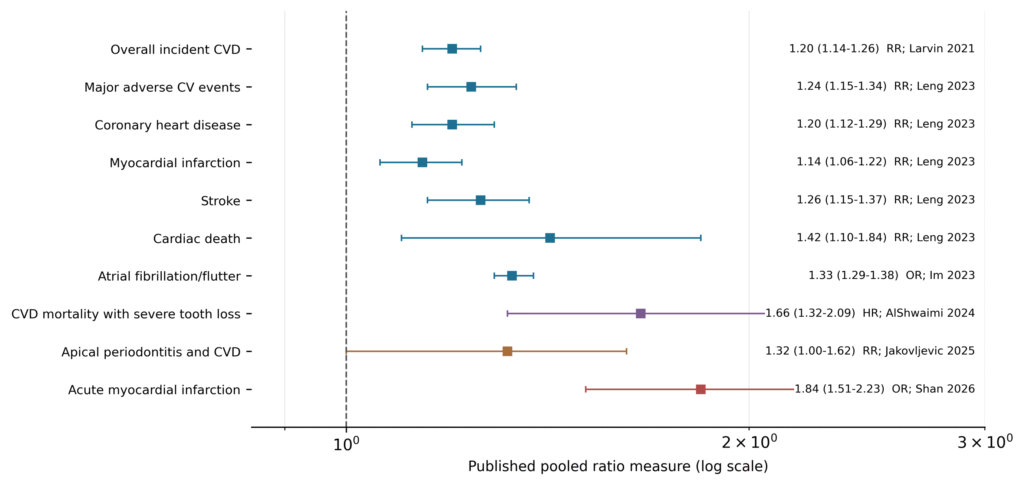
The reanalysis of 26 longitudinal reports consistently oriented toward adverse oral-disease exposure yielded a pooled ratio measure of 1.55 (95% CI 1.35-1.78; I²=92.4%), with a wide 95% prediction interval (0.78-3.07). Published syntheses associated periodontal disease with incident cardiovascular disease (RR 1.20), major cardiovascular events (RR 1.24), coronary heart disease (RR 1.20), myocardial infarction (RR 1.14), stroke (RR 1.26), cardiac death (RR 1.42), and atrial fibrillation/flutter (OR 1.33). Severe tooth loss was associated with cardiovascular mortality (HR 1.66), whereas high versus low toothbrushing frequency was protective (RR 0.85). A 2026 acute-myocardial-infarction meta-analysis reported OR 1.84, attenuating to 1.26 after trim-and-fill; randomized evidence for prevention of hard cardiovascular events remained insufficient. Conclusions: Poor oral health is a reproducible marker of elevated cardiovascular risk, although residual confounding, exposure misclassification, review overlap, and high heterogeneity preclude causal claims. Oral assessment can support integrated risk detection, but periodontal care should complement rather than replace established cardiovascular prevention.
Article
Periodontitis, substantial tooth loss, and unfavorable oral-hygiene indicators are consistently associated with cardiovascular morbidity and mortality. Associations are generally modest for coronary disease and myocardial infarction and larger for selected stroke, arrhythmia, and mortality analyses, but heterogeneity and residual confounding remain pronounced.
For adults with established CVD, severe periodontitis should prompt coordinated care because recurrent-event risk may be higher and invasive procedures can interact with antithrombotic management. Routine periodontal treatment is generally compatible with cardiovascular care when bleeding risk and medication are reviewed appropriately. Unnecessary interruption of antiplatelet or anticoagulant therapy should be avoided and decisions should follow procedure-specific guidance.
Available online September 02, 2026
2308-8567/© 2026 The Authors. Published by Elsevier Inc. This is an open access article under the CC BY license (http://creativecommons.org/licenses/by/4.0/).